
The Transport vs. Control Split
While standards like IPMX and ST 2110 have mastered media transport, they often lack a vital component: control. Moving high-fidelity signals across IP is merely part of the challenge. In the absence of a unified control plane, broadcast engineers are forced into the manual and tedious task of managing SDP files, port numbers, and IP addresses between equipment — a workflow that fails to scale.
The AMWA NMOS (Networked Media Open Specifications) addresses these configuration bottlenecks by providing the necessary “control glue.” By using standard web technologies such as JSON and REST APIs to automate discovery and routing, NMOS converts complex network environments into a “plug-and-play” broadcast matrix, restoring the simplicity once found in traditional SDI setups.
Adopting NMOS is now a necessity for anyone seeking to develop a vendor-neutral and flexible IP media infrastructure.
The Three Pillars of IP Media: Transport, Timing, and Control
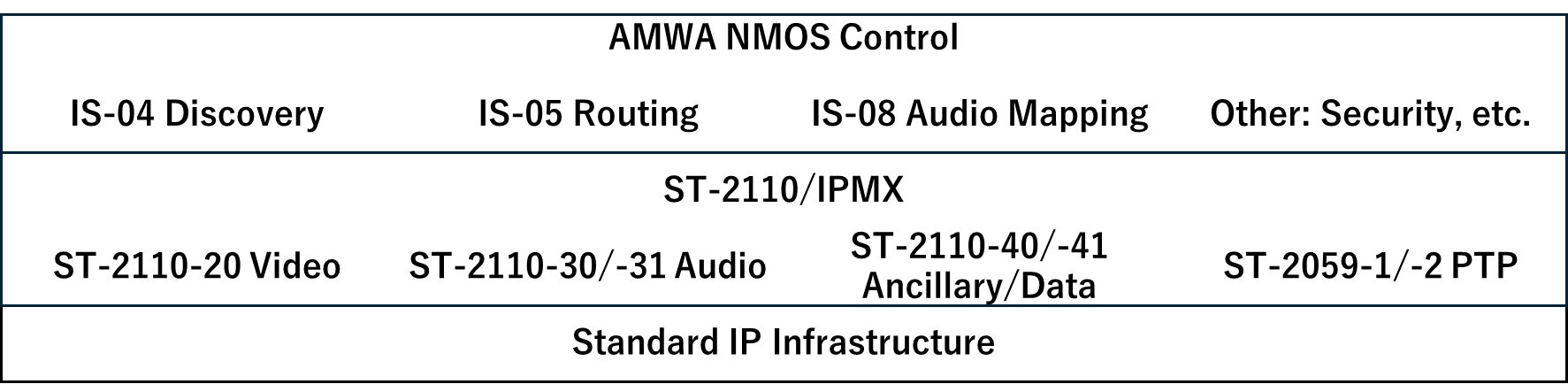
To understand how an IP media facility operates, it helps to divide the network into three distinct operational pillars:
- Transport Layer (SMPTE ST 2110 & IPMX): Moves raw audio samples, video pixels, and ancillary data across standard IP networks with ultra-low latency.
- Timing Layer (SMPTE ST 2059): Replaces traditional analog genlock with Precision Time Protocol (PTP IEEE 1588). ST 2059 ensures that every camera frame, audio sample, and data packet shares a universal clock with nanosecond precision.
- Control Layer (AMWA NMOS): Acts as the network orchestrator — discovering devices, mapping capabilities, and handling signal routing between endpoints.
Broadcast & Production (SMPTE ST 2110)
Live TV facilities manage thousands of unicast and multicast RTP streams. Manually configuring these flows is impossible during a fast-paced live production. NMOS acts as an open matrix, allowing central broadcast controllers to query available feeds and route them dynamically to monitors, switchers, or record channels without human operator involvement in IP network mechanics.
ProAV & Enterprise (IPMX)
In corporate auditoriums, conference centers, or stadiums, dedicated video engineers don’t manage everyday operations. Connections must work immediately out of the box. For this reason, IPMX makes NMOS IS-04 and IS-05 mandatory. IPMX also extends NMOS to support AV-specific requirements, such as display metadata (EDID), HDCP content protection, and USB-over-IP routing.
Under the Hood: The Core NMOS Logical Model
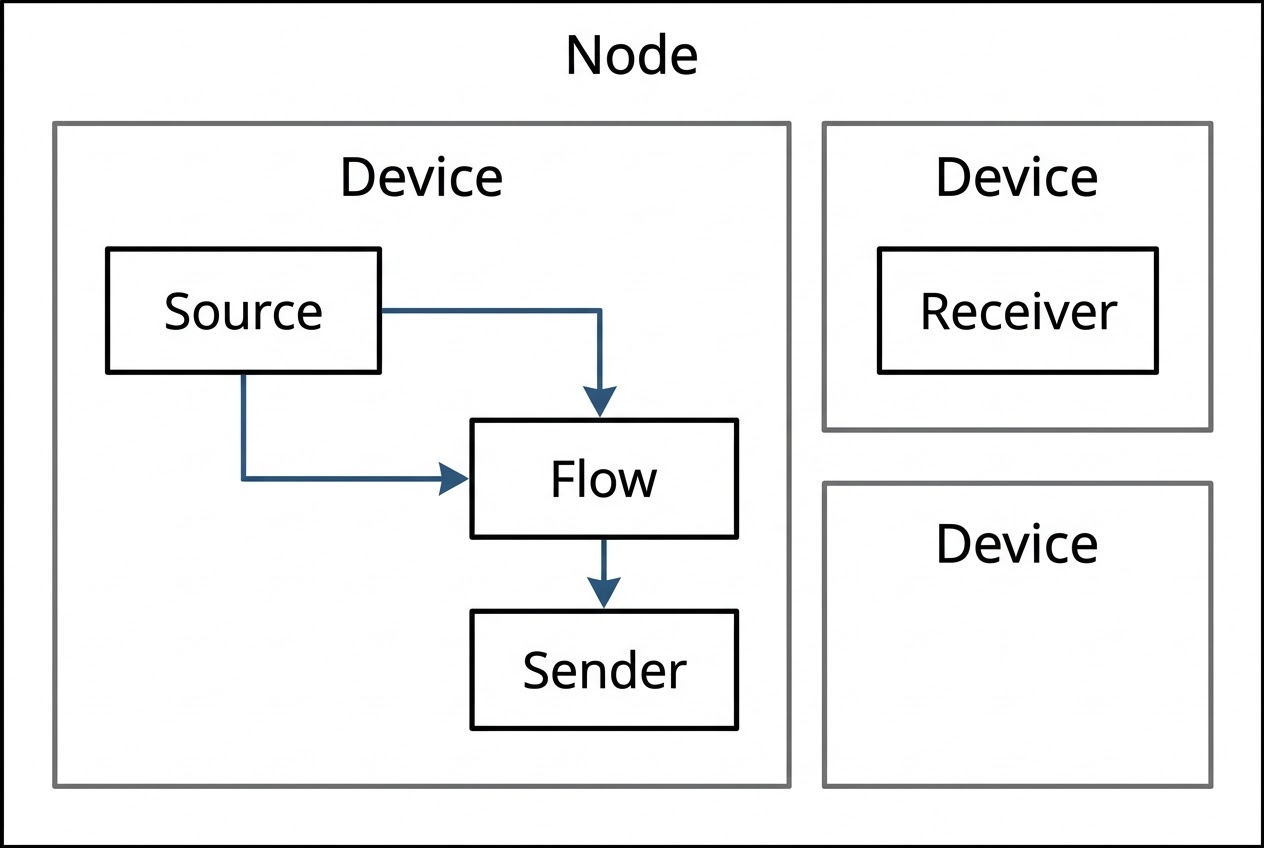
To organize media flows logically, NMOS defines a standardized 5-layer hierarchy. This model abstracts physical equipment into predictable virtual components:
- Layer 1: Node — The physical hardware box or virtual machine host connected to the network (e.g., a 1RU IP gateway or an IP camera).
- Layer 2: Device — A logical sub-grouping inside a Node (e.g., “Gateway Channel A” or a “Virtual Multi-viewer Instance”).
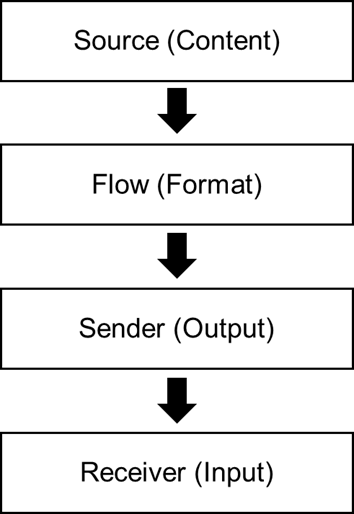
- Layer 3: Source — The abstract origin of the signal content (e.g., “Studio Camera 1” or “Color Bar Generator”).
- Layer 4: Flow — The digital representation/encoding of a Source (e.g., an uncompressed 1080p59.94 ST 2110-20 video stream).
- Layer 5: Sender/Receiver — The sender is the egress network point/process that transmits the Flow as RTP packets onto the network. The receiver is the ingress network point/process that accepts and decodes an incoming Flow from the network.
The Central Matchmaker: The NMOS Registry (RDS)
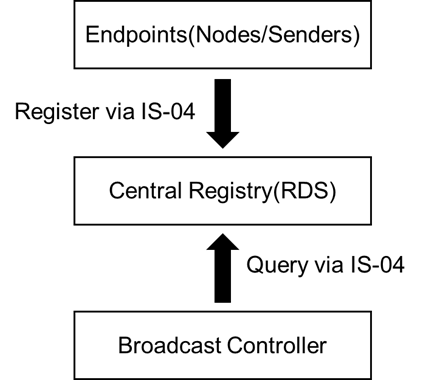
While Nodes contain and process media resources, the Registry — often referred to as the Registration and Discovery System (RDS) — acts as the central directory for the entire facility, similar to an automated network address book:
- Self-Registration: When a Node boots up, it automatically discovers the Registry using standard network protocols (mDNS or DNS-SD) and uploads its complete logical model (its Senders, Receivers, and capabilities) using IS-04 HTTP POST requests.
- Central Database: The Registry maintains a real-time database of every active media endpoint on the network.
- Controller Queries: Instead of scanning hundreds of individual endpoints across the network, broadcast controllers query the Registry’s IS-04 Query API to instantly locate available feeds.
Beyond IS-04 & IS-05: The Broader NMOS Specification Family
While IS-04 (Discovery) and IS-05 (Connection) form the baseline of NMOS, AMWA’s ecosystem extends far beyond these two specifications. To address complex operational workflows, AMWA categorizes its documentation into distinct naming conventions:
Interface Specifications (IS): Core REST API standards defining how systems interact.
- IS-08 (Audio Channel Mapping): Allows matrix-style audio shuffle and channel reassignment prior to network transmission.
- IS-09 (System Parameters): Automatically provides global facility settings (such as PTP system domains) to newly connected Nodes.
- IS-10 (API Security): Defines authorization and encryption mechanisms for secure NMOS control planes.
Best Current Practices (BCP): Recommendations for implementing specs in real-world scenarios.
- BCP-002-01 (Grouping): Standardizes how related Senders and Receivers (e.g., video, audio, and metadata belonging to the same camera) are grouped together visually for operators.
- BCP-003-01 (NMOS Security): Guidelines for securing REST APIs via TLS encryption.
Modeling Specifications (MS) & Architectural Specifications (AS): Higher-level frameworks that define data structures, media control abstractions, and system architecture boundaries to guide future development.
The specifications above cover the very basics of NMOS from the many available. Together, these specifications ensure that NMOS can evolve from basic stream switching to full-facility management.
Weighing the Options: Pros and Implementation Considerations
NMOS is an open specification, not an off-the-shelf commercial application. Its success in a facility depends on how well hardware manufacturers and software developers implement it.
Key Advantages
- Vendor-Neutral Interoperability: Prevents vendor lock-in by providing a unified control language for all ST 2110 and IPMX devices.
- Automated Workflow: Replaces manual configuration spreadsheet errors with dynamic network self-discovery.
- Scalability: Built on standard web technology, allowing control software to scale seamlessly from small OB trucks to multi-building broadcast centers.
Implementation Considerations
- Development Complexity: Implementing NMOS on custom embedded hardware requires a thorough understanding of the AMWA REST APIs and underlying media pipelines.
- Open-Source vs. Commercial Stack: While open-source NMOS stacks exist (e.g., Sony’s nmos-cpp), production environments usually benefit from commercial SDKs such as those from ADEAS/Nextera, which provide formal maintenance, security patching, and ongoing compliance testing.
Glossary
- Egress / Ingress: Respectively, network traffic leaving a device and network traffic entering a device.
- Endpoint: A network-accessible source or destination of a media stream, such as an NMOS Sender or Receiver.
- RTP (Real-time Transport Protocol): The protocol commonly used to carry real-time video, audio, and data streams over an IP network.
- SDP (Session Description Protocol): A text description containing the technical parameters required to identify and receive a media stream, such as IP addresses, ports, and media format.
- REST API: A standardized web-based interface allowing software applications and devices to exchange information and commands, used extensively by NMOS.
- Multicast: A network transmission method in which one Sender can distribute the same stream efficiently to multiple Receivers.
- Control Plane: The part of the system responsible for discovery, configuration, and routing decisions, rather than carrying the actual media.
- IPMX (Internet Protocol Media Experience): An open standard based on SMPTE ST 2110 designed to provide a complete, interoperable solution for ProAV applications over standard IP networks.
- PTP (Precision Time Protocol / IEEE 1588): A network protocol used to synchronize clocks across devices with nanosecond-level accuracy, replacing traditional analog genlock in IP facilities.
- Unicast: A network transmission method where a single Sender transmits a stream to one specific Receiver (point-to-point), contrasted with multicast.
- Genlock: A synchronization method used in traditional legacy video systems to lock the frame timing of multiple video sources, which PTP replaces in modern IP systems.
- mDNS / DNS-SD: The standard protocols that NMOS Nodes use to automatically discover and connect to the Registry on a network without manual configuration.
- SDK (Software Development Kit): A collection of software tools and libraries that developers use to implement specific features or protocols (such as NMOS) within their products.
References & Further Reading
- AMWA NMOS Specification Overview & Documentation Repository: specs.amwa.tv/nmos
- AMWA IS-04 (Discovery and Registration): specs.amwa.tv/is-04
- AMWA IS-05 (Connection Management): specs.amwa.tv/is-05
- EBU Technology Pyramid for Media Nodes (Minimum User Requirements for IP Infrastructure): tech.ebu.ch/pyramid
- EBU Tech 3371: NMOS Testing and Deployment Guidelines
- VSF TR-10 Suite: Internet Protocol Media Experience (IPMX) Technical Recommendations (Defines the IPMX framework and NMOS requirements for ProAV).
- VSF TR-08: Transport of SMPTE ST 2110-22 (JPEG XS) in ST 2110 Systems. vsf.tv/technical_recommendations.shtml
- SMPTE ST 2110 Professional Media Over Managed IP Networks Standard Suite: smpte.org
- SMPTE ST 2059-1 / ST 2059-2 (Precision Time Protocol / PTP for Music & Video): smpte.org
- Adeas & Nextera ST 2110, IPMX, and NMOS Core IP / FPGA SDK Solutions: adeas.nl / nexteravideo.com
- MBS TechBlog: technexus-blog.mbs.jp/2025/05/nmos.html
- IP Showcase 2022: aimsalliance.org — IP Showcase NMOS Tutorial (Nextera)
Eng. Edgar Carlos, Ph.D., is a Senior Product Engineer at Village Island. A graduate of Tokyo Tech (now Institute of Science Tokyo), he specializes in advanced broadcast technologies and IP-based media systems, with deep expertise in SMPTE ST 2110, PTP synchronization, and JPEG-XS workflows. He has extensive experience in the design, integration, and validation of next-generation broadcast solutions, supporting major international events and leading manufacturers with field-proven insights.

